


In recent years, cloud-native applications have become increasingly popular due to their scalability, resiliency, and agility. Cloud-native applications are designed to run on cloud platforms and leverage the capabilities of the cloud to achieve their goals. To develop effective cloud-native applications, it is essential to follow a set of design principles that ensure the application is scalable, fault-tolerant, and easy to maintain. In this article, we will discuss some of the key design principles for cloud-native applications.
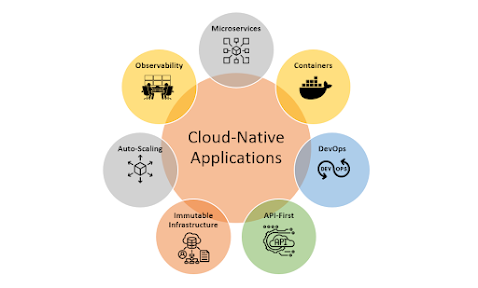
- Microservices
Architecture: The microservices architecture is a design pattern that
structures an application as a collection of small, independent services.
Each service performs a specific function and communicates with other services
using lightweight protocols such as REST. This architecture is ideal for
cloud-native applications as it allows each service to scale
independently, making the application more resilient and fault-tolerant.
- Containers:
Containers are lightweight and portable units of software that can run
anywhere, making them ideal for cloud-native applications. Containers
enable applications to run consistently across different environments,
making them easier to deploy and manage. Docker is the most popular containerization
technology used in cloud-native applications.
- DevOps:
DevOps is a set of practices that combines software development and
operations to streamline the software delivery process. In cloud-native
applications, DevOps is critical as it enables continuous delivery and
deployment of software updates. DevOps practices such as automation,
continuous integration, and continuous delivery make it easier to deploy
and maintain cloud-native applications.
- API-First
Design: API-first design is a development approach that prioritizes the
design and implementation of APIs before building the user interface. This
approach ensures that the application's backend is designed to be
flexible, scalable, and interoperable, making it easier to integrate with
other systems. APIs enable different services to communicate with each
other, making the application more modular and flexible.
- Immutable
Infrastructure: Immutable infrastructure is an approach to infrastructure
management that treats infrastructure as code. With this approach,
infrastructure changes are made by creating a new version of the
infrastructure instead of updating the existing infrastructure. This
approach ensures that the infrastructure is consistent, reliable, and can
be easily reproduced in case of failure.
- Auto-Scaling:
Auto-scaling is a feature that enables cloud-native applications to adjust
resource usage automatically based on demand. Auto-scaling ensures that
the application can handle fluctuations in traffic and workload, making it
more resilient and fault-tolerant. Cloud platforms such as Microsoft
Azure, Amazon Web Services (AWS) and Google Cloud Platform (GCP) offer
auto-scaling features that can be easily integrated into cloud-native
applications.
- Observability:
Observability is the ability to understand the internal state of an
application using data collected from its external behaviour.
Observability is critical in cloud-native applications as it enables
developers to monitor the application's health, detect issues, and
troubleshoot problems quickly. Tools such as Prometheus and Grafana can be
used to monitor and analyse application metrics in real-time.
In conclusion, designing cloud-native applications requires a different approach than traditional software development. By following the design principles outlined above, developers can create cloud-native applications that are scalable, resilient, and easy to maintain. Microservices architecture, containers, DevOps, API-first design, immutable infrastructure, auto-scaling, and observability are all essential components of a well-designed cloud-native application. By adopting these principles, developers can build applications that take full advantage of the cloud's capabilities and deliver value to their users.
